People increasingly ask AI instead of typing into a search box. But the three biggest names — ChatGPT, Gemini, and Perplexity — take very different approaches to answering your questions. One is a conversational all-rounder, one is wired into Google’s index, and one is built purely for cited research. Which actually gives you the best answers?
We ran the same set of real-world questions — factual lookups, current events, product research, and deep questions — through all three. Here is the honest verdict.
Quick Answer: Which One Wins?
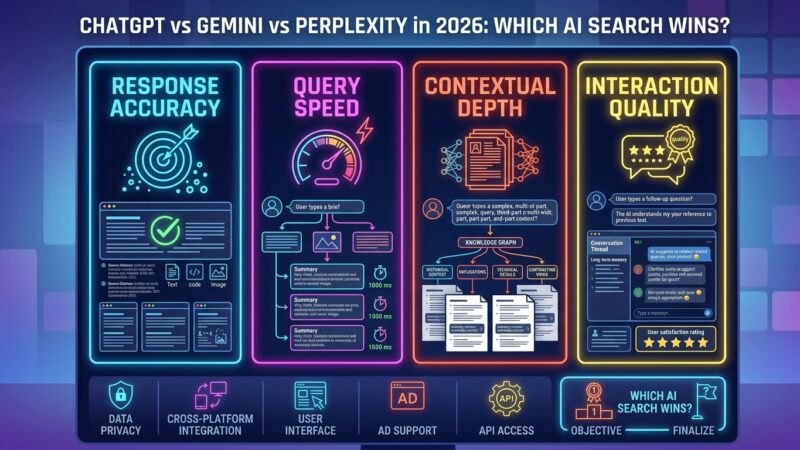
There is no single winner — each is best at a different job. Perplexity wins for research you need to trust and cite. Gemini wins for current information and anything tied to Google. ChatGPT wins when you want to search and then keep working with the answer. Here is how they compare head to head.
Head-to-Head Comparison
| Feature | ChatGPT | Gemini | Perplexity |
|---|---|---|---|
| Shows sources / citations | ✓ Sometimes | ✓ Yes | ✓ Always |
| Best for current events | ✓ Good | ✓ Excellent | ✓ Excellent |
| Follow-up conversation | ✓ Excellent | ✓ Good | ✓ Good |
| Free version available | ✓ Yes | ✓ Yes | ✓ Yes |
| Best for deep work after searching | ✓ Best | ✓ Good | ✗ Limited |
| Trustworthiness of answers | ✓ Good | ✓ Good | ✓ Best |
Perplexity — Best for Research You Can Trust
- ✓ Cites sources on every answer
- ✓ Excellent for fact-checking and research
- ✓ Clean, distraction-free answers
- ✗ Weaker for long creative or coding tasks
- ✗ Less conversational than ChatGPT
Gemini — Best for Current Info and Google Users
- ✓ Best for up-to-the-minute information
- ✓ Deep Google Workspace integration
- ✓ Strong for local and factual queries
- ✗ Can be inconsistent on complex reasoning
- ✗ Fewer third-party integrations than ChatGPT
ChatGPT — Best for Searching Then Working
- ✓ Best for turning answers into finished work
- ✓ Widest feature set (images, voice, analysis)
- ✓ Excellent follow-up conversation
- ✗ Citations less consistent than Perplexity
- ✗ Best search features often need a paid plan
Which One Should You Use?
The honest truth: All three have strong free plans, so you do not have to choose just one. The smartest approach is to use Perplexity for trustworthy research, Gemini for current and Google-based questions, and ChatGPT when you want to turn an answer into finished work — all at no cost.
AI search tools change fast. Features and free-plan limits were accurate at the time of writing — check each tool’s official site for the latest.