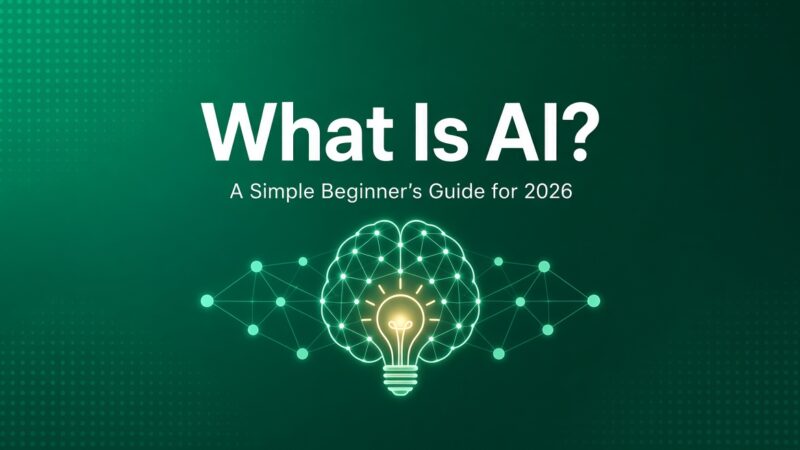
AI is everywhere in the news, in apps, and in conversations — but if you have felt too embarrassed to ask what it actually is, you are not alone. This guide explains artificial intelligence in plain English, with no jargon and no technical background needed. By the end, you will understand what AI is, how it works, and how to start using it yourself.
What Is AI, Really?
Artificial intelligence (AI) is technology that lets computers do things that normally require human intelligence — like understanding language, recognizing images, answering questions, or making decisions. Instead of following rigid, pre-written instructions for every situation, AI learns patterns from huge amounts of examples and uses them to handle new situations.
Think of it like this: a traditional program is a recipe that must be followed exactly. AI is more like a chef who has tasted thousands of dishes and can now improvise a new one. That is why AI can write, chat, and create in ways older software never could.
In one sentence: AI is software that learns from examples to understand, predict, or create — rather than being told exactly what to do for every case.
How Does AI Actually Work?
Most of today’s popular AI, like ChatGPT, works by being “trained” on enormous amounts of text and data. During training, it learns the patterns of how words, ideas, and images relate to each other. When you ask it something, it uses those learned patterns to predict a helpful response, one piece at a time.
It does not “think” or “understand” the way humans do — it is recognizing and continuing patterns extremely well. That is why it can sound remarkably human but also occasionally make confident mistakes. Knowing this helps you use it wisely.
Common Types of AI You’ll Meet
Is AI Safe to Use?
For everyday tasks, yes — millions use AI tools daily for writing, learning, and work. But a few sensible habits matter: do not share private or sensitive information with AI chatbots, always double-check important facts (AI can be confidently wrong), and remember that AI output is a starting point you should review, not a final authority. Used thoughtfully, AI is a helpful tool, not something to fear.
Three golden rules for beginners: 1) Never share sensitive personal or financial details. 2) Always fact-check important information. 3) Treat AI as a helpful assistant whose work you review — not an infallible expert.
How to Start Using AI Today (Free)
- ✓ Try a free chatbot — visit ChatGPT, Claude, or Gemini and just ask it a question in plain language.
- ✓ Start with simple tasks — ask it to explain something, write an email, or summarize an article.
- ✓ Be specific — the more detail you give, the better the answer you get back.
- ✓ Experiment freely — you cannot break anything; the best way to learn AI is to play with it.
- ✓ Always review the output — check facts and adjust the result to fit your needs.
Frequently Asked Questions
What is AI in simple terms?
AI, or artificial intelligence, is technology that lets computers do things that normally need human intelligence — like understanding language, answering questions, or creating images. It learns patterns from lots of examples instead of following fixed instructions.
Is AI the same as ChatGPT?
No. ChatGPT is one popular example of AI — specifically a chatbot. AI is the broader technology behind many things, including image generators, voice assistants, and recommendation systems on sites like Netflix and YouTube.
Do I need technical skills to use AI?
Not at all. Modern AI tools like ChatGPT are designed to be used with plain, everyday language. You simply type or speak what you want, just like talking to a helpful assistant. No coding or technical background is required.
Is AI free to use?
Many powerful AI tools have free versions, including ChatGPT, Claude, and Gemini. You can start using them at no cost, and only pay if you later want higher limits or advanced features.
Can AI replace human jobs?
AI is changing many jobs by automating certain tasks, but it also creates new opportunities. For most people, the practical takeaway is that learning to use AI as a tool makes you more productive and valuable, rather than being replaced by it.
The bottom line: AI is simply software that learns from examples to help you write, create, and answer questions. The best way to understand it is to try a free tool like ChatGPT today and ask it anything — you will learn more in five minutes of playing than in any explanation.
AI tools evolve quickly. The tools and features mentioned were accurate at the time of writing — check each tool’s official site for the latest.